
Social Anxiety
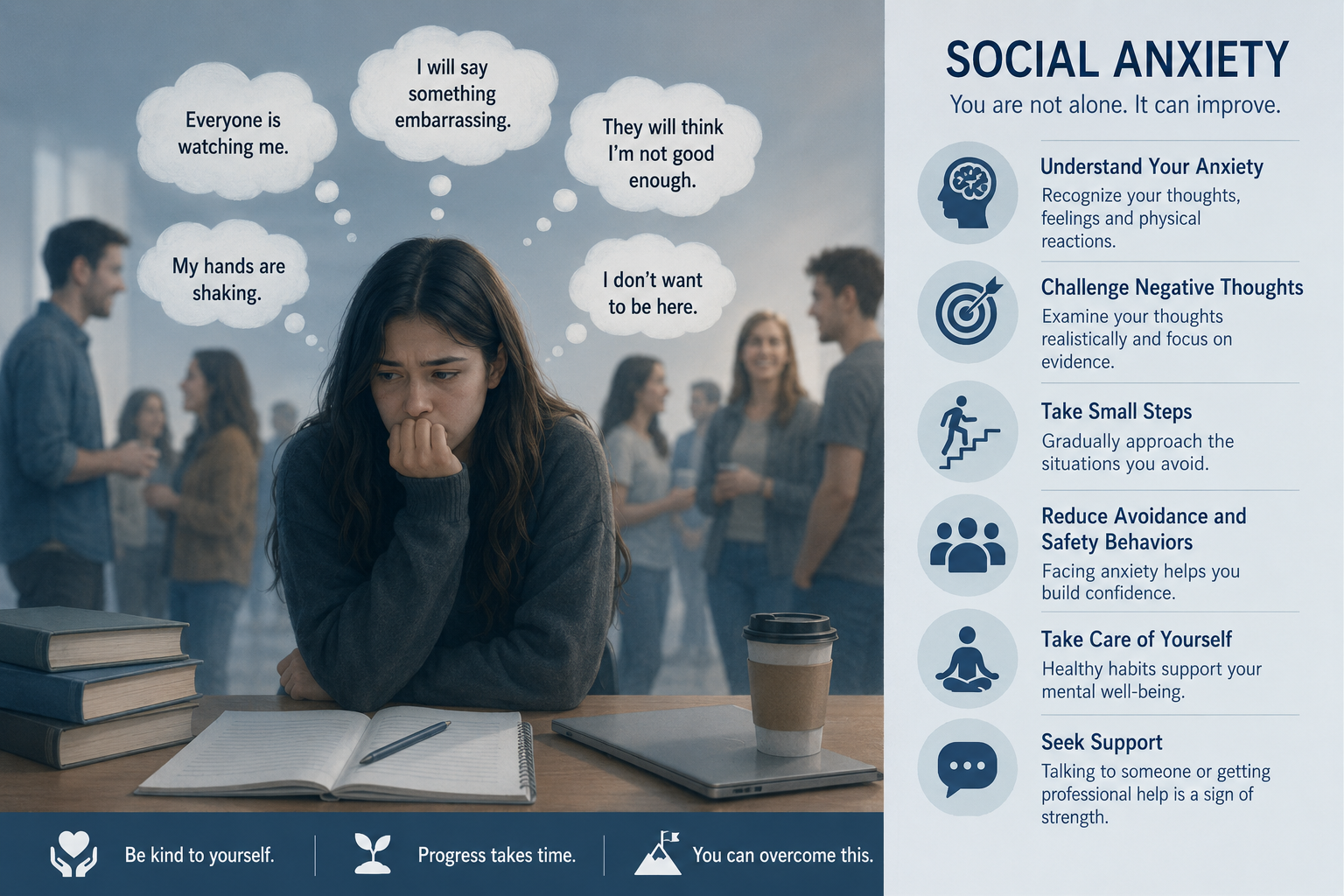
Social Anxiety and Strategies for Managing Social Anxiety
Social anxiety refers to the significant fear and anxiety experienced in social situations in which an individual believes that they may be observed, evaluated, criticised or humiliated by others. Activities such as speaking in public, meeting new people, contributing to a class discussion, attending a meeting, making a telephone call, being observed while eating or speaking to someone in a position of authority may cause anxiety for some individuals.
Experiencing occasional nervousness in social settings is a normal part of life. Feeling anxious before joining a new group, giving a presentation or attending an important meeting does not, in itself, indicate the presence of a mental health disorder. In social anxiety disorder, however, fear and avoidance are more intense and persistent and may significantly restrict an individual’s academic, professional, social or personal functioning.
Social anxiety does not simply mean “being shy.” Shyness may be regarded as a personality characteristic and does not necessarily place significant limitations on a person’s life. In social anxiety, however, the individual may experience intense anxiety in social situations, monitor themselves excessively, believe that they will be judged negatively and consequently withdraw from important opportunities.
Key Features of Social Anxiety
At the centre of social anxiety is often the fear of being negatively evaluated by others. An individual may believe that they will appear anxious, incompetent, boring, inadequate or unusual.
They may also worry that other people will notice signs of anxiety such as blushing, trembling hands, changes in their voice, sweating, hesitating while speaking or forgetting what they intended to say.
Individuals experiencing social anxiety may become mentally preoccupied not only during a social situation but also before and after it.
Before a Social Situation
Thoughts such as the following may arise:
• “I will not be able to think of anything to say.”
• “Everyone will notice how nervous I am.”
• “I am going to say something ridiculous.”
• “No one will want to talk to me.”
• “If I give a poor presentation, everyone will think I am incompetent.”
During a Social Situation
Rather than focusing on the conversation or the people around them, the individual may direct their attention towards their own behaviour and physical symptoms.
They may continuously monitor how they appear, whether their voice is trembling or whether their face is becoming red.
After a Social Situation
The individual may repeatedly review the interaction in their mind:
• “Why did I say that?”
• “I must have looked very strange.”
• “Everyone noticed my mistake.”
• “I should never enter a situation like that again.”
This form of evaluation may cause the individual to focus more heavily on perceived mistakes and negative interpretations than on how the social situation actually unfolded.
Social Anxiety in University Life
University life involves numerous social and academic interactions and may therefore be particularly challenging for students experiencing social anxiety.
Situations that may cause anxiety include:
• Speaking or asking a question in class;
• Giving a presentation;
• Taking an oral examination;
• Participating in group work;
• Meeting with a member of the academic staff;
• Asking an academic adviser for assistance;
• Establishing new friendships;
• Joining student clubs or attending events;
• Sitting alone in the dining hall;
• Feeling that one is attracting attention on public transport;
• Making telephone calls;
• Worrying about being misunderstood when writing a message or email;
• Attending a job or internship interview;
• Speaking to someone of another gender or to someone in whom one has a romantic interest;
• Expressing an opinion within a group;
• Eating or writing in front of others; and
• Posting on social media.
Social anxiety may affect not only a student’s social life but also their educational experience. A student may avoid speaking in class even when they know the answer, refrain from asking questions about subjects they do not understand, remain in the background during group work or avoid courses that require presentations.
Over time, this may result in reduced academic performance, a weakened sense of self-efficacy and a diminished sense of belonging to the university.
Symptoms of Social Anxiety
Social anxiety may present through cognitive, emotional, physical and behavioural symptoms. The type and intensity of these symptoms may vary from person to person.
Cognitive Symptoms
• Believing that others will evaluate them negatively;
• Believing that making a mistake is unacceptable;
• Thinking that everyone in a social setting is watching them;
• Believing that they will be unable to think of anything to say;
• Assuming that even a minor mistake will be noticed by everyone;
• Interpreting other people’s facial expressions negatively;
• Viewing silence or a short pause as a failure;
• Attributing successful social experiences to chance;
• Viewing negative experiences as evidence of personal inadequacy;
• Repeatedly reviewing social interactions afterwards; and
• Worrying about an upcoming social situation long before it occurs.
Emotional Symptoms
• Intense anxiety and fear;
• Shame;
• Embarrassment;
• Tension;
• Feelings of inadequacy;
• Anger towards oneself;
• Fear of rejection;
• Feelings of helplessness in social settings;
• Loneliness; and
• Disappointment.
Physical Symptoms
• Blushing or a sensation of heat in the face;
• Sweating;
• Trembling in the hands or voice;
• A sensation of an increased heart rate;
• Rapid breathing;
• Dry mouth;
• Nausea or abdominal discomfort;
• Dizziness;
• Muscle tension;
• Hoarseness or trembling of the voice;
• Feeling that one’s mind has gone blank;
• Difficulty finding words while speaking; and
• An increased need to use the toilet.
Although these symptoms may be associated with social anxiety, newly emerging, severe or persistent physical symptoms should not automatically be attributed to anxiety. A medical assessment should be obtained where necessary.
Behavioural Symptoms
• Avoiding social settings;
• Declining invitations;
• Avoiding speaking in class;
• Avoiding eye contact;
• Speaking very briefly or in a restricted manner;
• Remaining in the background during meetings or events;
• Avoiding meeting new people;
• Avoiding courses involving presentations or oral examinations;
• Arriving late or leaving a social setting early;
• Remaining only in the company of familiar people;
• Avoiding telephone calls;
• Failing to ask for help even when assistance is needed;
• Using alcohol or other substances in order to participate in social situations; and
• Constantly using a mobile phone as a means of appearing occupied in social settings.
How Is Social Anxiety Maintained?
Social anxiety often continues within a cycle in which thoughts, physical responses, attention, avoidance and safety behaviours influence one another.
For example, before a presentation, a student may think:
“Everyone will notice how anxious I am.”
This thought may cause an increase in heart rate and a sensation of blushing. The student may then focus on their voice, face and hands rather than on the subject of the presentation. During the presentation, they may avoid eye contact, speak very quickly or read their notes word for word.
Afterwards, the student may disregard the positive aspects of the presentation and focus only on the few seconds during which they hesitated. They may then conclude:
“I am unable to give presentations.”
As a result, the next presentation may appear even more threatening.
The main factors that may maintain this cycle are explained below.
Avoidance Behaviour
Avoidance means not participating in anxiety-provoking social situations or remaining as far away from them as possible.
Examples may include:
• Dropping a course to avoid giving a presentation;
• Avoiding asking questions in class;
• Not attending a student event;
• Repeatedly declining invitations; and
• Ignoring a problem rather than speaking to a member of the academic staff.
Avoidance may reduce anxiety in the short term. However, it prevents the individual from discovering whether the situation is truly as dangerous as they believe, experiencing that anxiety may decrease over time and developing their social skills.
For this reason, avoidance may contribute to the continuation of social anxiety in the longer term.
Safety Behaviours
Safety behaviours are actions used to prevent a feared outcome from occurring or to conceal anxiety.
Examples include:
• Mentally preparing every sentence before speaking;
• Continuously avoiding eye contact;
• Speaking as little as possible;
• Speaking very quickly to prevent one’s voice from trembling;
• Dressing in a particular way to conceal blushing;
• Keeping one’s hands in one’s pockets to prevent them from being seen;
• Attending an event only with a familiar person;
• Constantly using a mobile phone;
• Repeatedly checking the other person’s facial expression during a conversation; and
• Consuming alcohol before entering a social setting.
These behaviours may provide a temporary sense of security. However, they prevent the individual from learning that the social situation may also be manageable without them.
Some safety behaviours may also make natural communication more difficult.
Excessive Self-Focused Attention
Individuals experiencing social anxiety frequently direct their attention towards their own body and behaviour in social settings. They may constantly monitor how they appear, how their voice sounds or whether other people have noticed their anxiety.
This intense self-monitoring may make it difficult to focus on the subject being discussed and on the other person. The individual may subsequently notice that they were unable to maintain their attention and interpret this as evidence of social inadequacy.
However, experiencing anxiety intensely within one’s own body does not necessarily mean that it is equally visible to others.
Excessive Post-Event Processing
Repeatedly reviewing an interaction after a social situation may maintain social anxiety. The individual will often disregard positive or neutral details and focus only on moments that they regard as mistakes.
For example, even when most of a conversation has gone well, the individual may remember only a brief silence and conclude that the entire interaction was unsuccessful.
Such evaluations are often based more heavily on negative impressions formed during anxiety than on objective evidence.
Strategies for Managing Social Anxiety
The objective of managing social anxiety is not to ensure that a person never experiences anxiety in a social situation.
Occasional excitement or uncertainty in social settings is natural. The primary objective is to enable the individual to participate in social, academic and professional activities that are important to them despite the presence of anxiety.
Identify Your Anxiety and the Situations You Avoid
The first step is to recognise which situations cause anxiety and what you do when you are in those situations.
The following questions may be helpful:
• In which social situations do I experience greater anxiety?
• What am I afraid will happen in this situation?
• What do I assume other people will think about me?
• Which physical symptoms do I experience when I feel anxious?
• Do I avoid this situation completely?
• Which behaviours do I use to conceal my anxiety?
• What are the short- and long-term consequences of avoidance?
• In which areas does this situation restrict my life?
Recording anxiety-provoking situations and your responses to them may help you understand the social anxiety cycle more clearly.
Examine Your Thoughts Realistically
Thoughts that arise during social anxiety often involve negative evaluation, mind-reading and catastrophising.
Examples include:
• “Everyone thinks I am boring.”
• “If my face becomes red, I will humiliate myself.”
• “If I mispronounce one word, the entire presentation will be ruined.”
• “If there is a silence, everyone will realise that I cannot hold a conversation.”
When these thoughts arise, you may ask yourself:
• Is this thought a fact or a prediction?
• Do I genuinely know what the other person is thinking?
• What specific evidence supports the outcome I fear?
• Is there any evidence that contradicts this thought?
• Could there be another explanation for the situation?
• How would I evaluate another person who made the same mistake?
• What is the most likely outcome?
• Could I cope if the situation I fear actually occurred?
For example, instead of thinking:
“If I pause during the presentation, everyone will think that I am incompetent,” a more balanced assessment may be:
“I may briefly pause during the presentation. Most people may regard this as normal. A short pause does not determine the overall quality of my presentation or my competence.”
The objective is not to convince yourself that everything will definitely go well. Rather, it is to examine negative predictions realistically and on the basis of evidence.
Approach Anxiety-Provoking Situations Gradually
Strong clinical evidence indicates that reducing avoidance and gradually approaching feared social situations may be helpful in managing social anxiety.
However, this does not mean entering the most difficult situation without any preparation.
Anxiety-provoking situations may first be arranged from easier to more difficult.
For example:
1 Ask a familiar person a brief question.
2 Speak to a cashier while making eye contact.
3 Begin a brief conversation with a classmate.
4 Express an opinion in a small study group.
5 Ask a question during a class.
6 Attend a student event for a short period.
7 Meet a member of the academic staff in person.
8 Give a short presentation in class.
9 Speak before a larger audience.
At the beginning, the individual may select a step that causes a low or moderate level of anxiety. The same situation may be repeated at different times.
It is not necessary to wait until anxiety has disappeared completely before moving to the next step.
The objective is not to perform perfectly. It is to learn that the individual can remain in the social situation despite anxiety and cope with the outcomes they fear.
Gradually Reduce Safety Behaviours
Simply attending social situations may not be sufficient. When an individual continues to use safety behaviours extensively, they may not learn that the situation is manageable without those behaviours.
For example, an individual may try:
• Looking at the audience occasionally rather than reading their notes word for word;
• Keeping their phone in their bag for a certain period rather than using it throughout an event;
• Allowing a conversation to develop naturally rather than preparing every sentence in advance; and
• Speaking briefly to another person rather than remaining exclusively beside someone they know.
Reducing safety behaviours gradually may be more manageable than attempting to discontinue all of them at once.
Direct Your Attention Towards Your External Environment
During social anxiety, constantly directing attention towards oneself may increase anxiety. Attention may therefore be consciously directed towards the subject being discussed, the other person’s words and the actual information available in the environment.
During a conversation, you may try to:
• Listen carefully to the other person’s sentences;
• Focus on their tone of voice and the subject they are discussing;
• Ask a natural follow-up question about what has been said; and
• Observe the external environment instead of imagining how you appear.
The objective is not to suppress physical symptoms by force. It is to direct attention towards the external world even when those symptoms are present.
Do Not Treat Social Situations as Performance Examinations
Social interactions are not examinations in which an individual is expected to speak perfectly, remain constantly interesting or prevent every moment of silence.
Pauses, misunderstandings, changes of subject and brief periods of silence are normal in everyday conversations.
For a conversation to be regarded as successful, the individual does not need to:
• Be funny or interesting at all times;
• Answer every question immediately;
• Display no signs of anxiety;
• Be liked by everyone; or
• Take full responsibility for maintaining the conversation.
Social communication is a process created through the shared participation of two or more people. A conversation not proceeding as expected does not necessarily indicate inadequacy on the part of one individual.
Practise Basic Social Skills
Social anxiety does not always result from a lack of social skills. Many people possess the necessary skills but find it difficult to use them because of anxiety.
Nevertheless, practising certain basic communication behaviours may help individuals feel more comfortable in social settings.
Behaviours you may try include:
• Making brief and natural eye contact;
• Greeting others;
• Asking open-ended questions;
• Asking a follow-up question related to what the other person has said;
• Briefly sharing your own opinion;
• Avoiding taking full responsibility for the conversation;
• Avoiding immediately interpreting silence in a catastrophic manner; and
• Politely ending the conversation at an appropriate time.
Complex sentences are not necessary in order to begin a conversation.
Simple expressions may be sufficient:
• “What do you think about this course?”
• “Which part of the assignment have you completed?”
• “Have you attended this event before?”
• “Did you also find today’s topic difficult?”
• “May I sit here?”
Allow Yourself to Make Mistakes
Individuals experiencing social anxiety may regard making mistakes or allowing their anxiety to be noticed as unacceptable.
However, occasionally confusing words, forgetting what one intended to say, remaining silent or being unable to answer a question immediately are normal aspects of social interaction.
You may remind yourself:
• Making a mistake does not mean that I have no social value.
• People may not remember most minor mistakes for as long as I imagine.
• Appearing anxious does not have to be dangerous or shameful.
• One person not liking me does not mean that everyone will reject me.
• Social skills may develop through experience.
The objective is not deliberately to make mistakes. It is to accept the possibility of mistakes as a natural part of life.
Limit Post-Event Evaluation
Repeatedly reviewing a conversation after a social situation may increase anxiety. When this process begins, a limited period may be allocated for evaluating the experience.
The following questions may be helpful:
• What facts about the event could I actually observe?
• Which parts are my interpretations or predictions?
• Which positive or neutral details am I overlooking?
• What realistic lesson can I draw from this situation?
• Is repeatedly thinking about this event helping me at the moment?
The individual should consider not only moments they regarded as mistakes but also their ability to remain in the social situation, contribute to the conversation or participate rather than avoid it.
Learn to Carry Anxiety Rather Than Suppress It
Waiting for anxiety to disappear completely before entering a social situation may contribute to continued avoidance.
The presence of anxiety does not mean that an individual is unprepared for the situation.
The individual may say:
• “I am experiencing anxiety at the moment, and I can still participate in this conversation.”
• “Anxiety may be uncomfortable, but it does not have to be dangerous.”
• “My objective is not to experience no anxiety; it is to remain here.”
• “My body is responding as though there is a threat. This response may decrease over time.”
This approach supports the individual in functioning alongside anxiety rather than attempting to eliminate it by force.
Use Breathing and Relaxation Exercises as Supporting Methods
Slow, unforced breathing or muscle-relaxation exercises may help reduce physical tension before a social situation.
However, these practices should not be regarded as the primary solution to social anxiety. When an individual believes that they can enter a social situation only after becoming completely calm, breathing exercises may themselves become a safety behaviour.
Relaxation exercises should therefore be used as supporting methods that make it easier to remain in the situation, rather than as alternatives to participating in it.
Review Your Use of Social Media
Social media may facilitate communication. However, constantly comparing oneself with other people’s lives, repeatedly checking likes or comments after posting and completely withdrawing from face-to-face communication may increase social anxiety.
The following adjustments may be helpful:
• Avoid constantly checking reactions to your posts;
• Limit accounts that increase your anxiety;
• Avoid allowing digital communication to replace face-to-face interaction entirely;
• Avoid trying to compose perfect sentences when writing messages;
• Reduce repeatedly checking messages before sending them; and
• Include regular, small face-to-face interactions in your daily life.
Do Not Use Alcohol or Other Substances as Coping Methods
Some individuals may use alcohol or other substances before entering social settings in an attempt to reduce their anxiety.
Although this may provide temporary relief, over time it may reduce the individual’s confidence in their ability to participate in social situations without substances and may lead to substance-related difficulties.
Professional support should be sought when an individual feels that they regularly need alcohol or another substance in order to enter social situations.
Use Supportive Language Towards Yourself
Belittling, blaming or humiliating oneself following a social interaction may increase social anxiety.
Instead of saying:
“I embarrassed myself again. I am incapable of doing anything properly,” a more balanced statement may be:
“I experienced anxiety during this conversation and found some moments difficult. Despite this, I participated in the conversation. Feeling more comfortable in social settings can develop through experience and repeated practice.”
Showing understanding towards oneself does not mean avoiding responsibility or giving up on personal development. It means evaluating one’s experience without using harmful or degrading language when difficulties arise.
Support a Healthy Daily Routine
Irregular sleep, excessive caffeine consumption, prolonged physical inactivity and irregular eating habits may increase the physical symptoms of anxiety.
The following practices may support general psychological well-being:
• Developing regular sleeping habits;
• Reducing excessive consumption of caffeine and energy drinks;
• Eating meals as regularly as possible;
• Incorporating physical activity into daily life; and
• Maintaining a balance between rest and social activities.
These practices are not, on their own, a treatment for social anxiety disorder. However, they may contribute to an individual’s capacity to manage anxiety.
When Should Professional Support Be Sought?
Experiencing occasional anxiety in social situations is normal. However, consulting a mental health professional is recommended when one or more of the following circumstances are present:
• Fear relating to social situations has continued for an extended period;
• Anxiety significantly restricts daily life;
• The individual avoids attending classes, giving presentations or participating in group work;
• Academic performance is affected by social anxiety;
• The individual is unable to establish new relationships or maintain existing ones;
• Job, internship or career opportunities are avoided;
• Social situations cause intense anxiety days or weeks in advance;
• The individual experiences prolonged self-blame and excessive evaluation following social interactions;
• Alcohol or other substances are used in order to participate in social settings;
• Anxiety is accompanied by depression, severe hopelessness or social isolation;
• Symptoms continue or become more severe despite the use of self-help strategies; or
• Thoughts of self-harm or suicide arise.
The assessment and diagnosis of social anxiety disorder should not be based solely on a list of symptoms. It should be conducted by a qualified mental health professional, taking into consideration the duration and intensity of the fear, avoidance behaviours, the individual’s cultural context and the effect on daily functioning.
Treatment of Social Anxiety
Social anxiety disorder is a treatable mental health condition. The treatment plan is determined according to the individual’s symptoms, life circumstances, preferences, physical health and any accompanying difficulties.
One of the psychological approaches with the strongest evidence for the treatment of social anxiety disorder is individual cognitive behavioural therapy specifically structured for social anxiety.
This approach may address the individual’s fear of negative evaluation, attentional focus, avoidance and safety behaviours and may support gradual engagement with feared social situations.
In certain circumstances, medication may also be considered following an assessment by a physician. Medication should be initiated, changed or discontinued only under medical supervision.
Medication prescribed for another person should not be used, and uncontrolled medication use for the purpose of reducing symptoms should be avoided.
Self-help resources may provide a useful starting point for some individuals. However, when symptoms are severe, have continued for an extended period or significantly affect daily functioning, such resources are not a substitute for professional treatment.
Conclusion
Social anxiety does not simply mean that a person is shy or does not enjoy speaking. The primary difficulty in social anxiety is that the fear of being negatively evaluated by others begins to restrict the individual’s life.
Although avoidance and safety behaviours may provide short-term relief, they may contribute to the continuation of social fears in the longer term.
Realistically evaluating one’s thoughts, directing attention towards the external environment, reducing safety behaviours and approaching feared social situations through small and carefully planned steps may be helpful in managing social anxiety.
The objective is not never to experience anxiety in social settings, to speak perfectly or to be liked by everyone.
The objective is to enable the individual to take steps that are important to them in their education, relationships, career and social life despite the presence of anxiety.
Quick Access
